PRAISE & CRITICISM
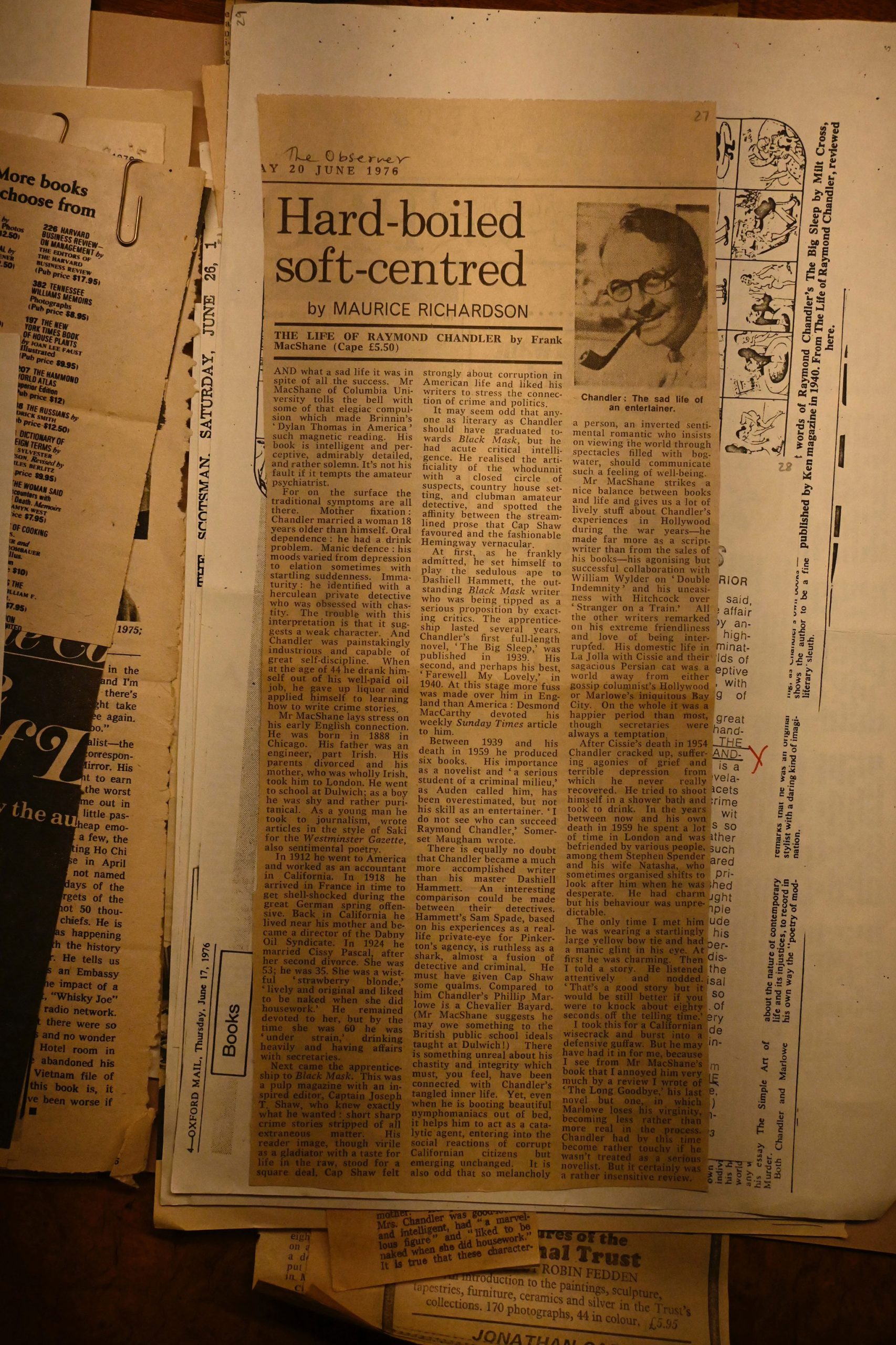
Raymond Chandler attracted admirers from the most unexpected quarters, contemporary critics who tried to rival his wife, and posthumous admiration. What follows is some of what they said.
CONTEMPORARIES
Raymond Chandler’s work drew both praise and criticism in his lifetime. Poet and critic W.H. Auden surveyed detective fiction in a 1948 essay for Harper’s Magazine and concluded that Chandler was writing “not detective stories, but serious studies of a criminal milieu, the Great Wrong Place” and they should be “judged not as escape literature, but as works of art.”
J.B. Priestley complained that he wished Chandler “would write something without murders in it.” Chandler was unimpressed: you slam murder mysteries, he wrote back, because they are usually written by people who can’t write well “and the moment you find someone who you are willing to admit can write well, you tell him he should not be writing murder mysteries.”
Ross Macdonald, author of the Lew Archer detective novels, said that he wrote “like a slumming angel” The tribute was generous given the history between them: Chandler had dismissed Macdonald as a “literary eunuch.”
In 1958, the BBC recorded a conversation between Chandler and Ian Fleming, a friend and author of the Bond novels, to mark the publication of Playback. (Fleming picked him up at eleven in the morning to find his voice already slurred with whisky.) On air, Fleming told him his dialogue was “some of the finest written in any prose today.”
The most significant critical attack of the era came from Edmund Wilson, America’s most influential literary critic, whose 1945 New Yorker essay “Who Cares Who Killed Roger Ackroyd?” savaged the detective fiction boom. Dorothy Sayers, Agatha Christie and Ngaio Marsh bore the brunt, but Chandler did not escape.
Reviewing Farewell, My Lovely, Wilson wrote that he ended it with his “old crime-story depression descending”, the explanations “neither interesting nor plausible enough” and the reader left “feeling cheated.” Chandler, who came off better than most, was unimpressed. He privately described Wilson as “a fat boor” who in his own fiction had made “fornication as dull as a railroad timetable.”


THE FILM CRITICS
Critics of the 1940s – some, it turns out, rather short-sighted – greeted the film noir Chandler adaptations with a mixture of admiration and exasperation. Bosley Crowther, the New York Times film critic, said of The Big Sleep in August 1946 that “a web of utter bafflement.” Bacall, he added, “still hasn’t learned to act.”
Murder, My Sweet fared better. Variety called it “as smart as it is gripping” though James Agee in The Nation offered the double-edged verdict: that it was “not really good except by comparison with the deadly norm.” The pattern was consistent: praise for atmosphere and performance, bewilderment at the plots.
Robert Altman’s The Long Goodbye (1973) had one of the more turbulent critical histories. United Artists promoted it as another hard-boiled detective movie. “It was anything but,” Altman said. It was badly reviewed in Los Angeles, flopped, and took eight months to open in New York. The LA Times dismissed Elliott Gould’s Marlowe as an “untidy, unshaven, semi-literate dimwit slob who could not locate a missing skyscraper.”
But it was a slow burn success. Pauline Kael, for the New Yorker recognised it as “a high-flying rap on Chandler and the movies… comic and melancholy… It’s probably the best American movie ever made that almost didn’t open in New York”. Roger Ebert, who had given it three stars on release, later placed it in his Great Movies collection, writing that “Altman undermines the premise of all private eye movies – that the hero can walk down mean streets, see clearly, and tell right from wrong.”
LATER WRITERS & ADMIRERS
The adulation endured into the next generation. Paul Auster, whose New York Trilogy hollows out the hard-boiled detective genre from within, said that Chandler “invented a new way of talking about America, and America has never looked the same to us since.”
Haruki Murakami would also grow up on his detective novels. “Raymond Chandler was my hero in the 1960s. I read The Long Goodbye a dozen times.” He freely admits to borrowing stylistically from Chandler: his own novel A Wild Sheep Chase had been affectionately nicknamed “The Big Sheep” by readers who recognised the debt.
Ian Rankin, creator of Inspector Rebus, called the opening paragraph of The Big Sleep his favourite in all crime fiction. Michael Connelly, whose Bosch novels owe Chandler an obvious debt, credits Chapter 13 of The Little Sister – a midnight drive through 1940s Los Angeles – with making him want to become a writer.
John Banville, the Booker Prize-winning Irish novelist commissioned by the Chandler estate to write a new Marlowe novel under his pen name Benjamin Black, said that: “Chandler invented a new kind of fiction, not just a new kind of crime fiction.”
And even more, Banville said: “He invented Los Angeles.”


MORE PRESS FROM THE ARCHIVE